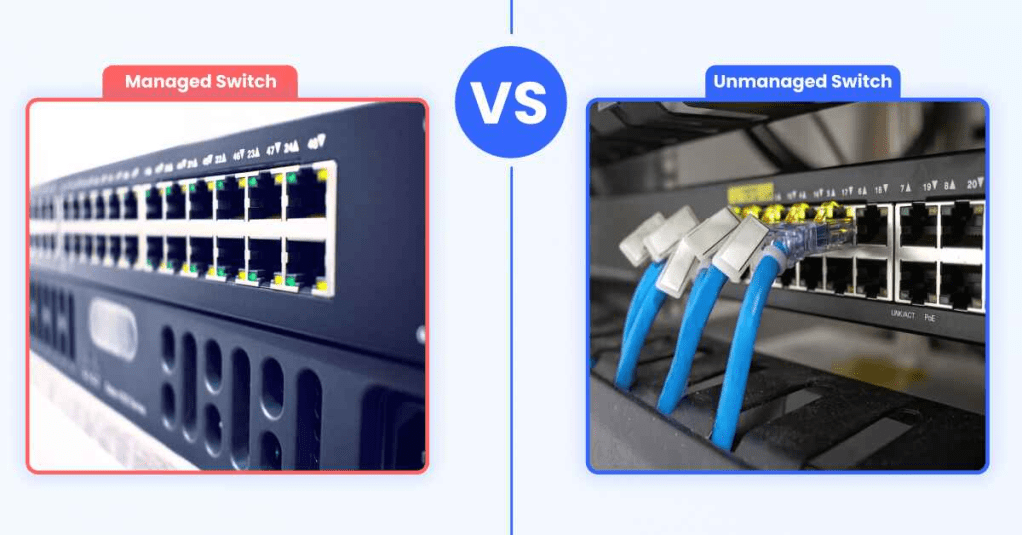
If you’re trying to decide between managed and unmanaged switches, you’re not alone. Understanding the difference between managed and unmanaged switches is important because the right choice affects your network’s performance, security, and future growth. In simple terms, unmanaged switches are plug-and-play devices, while managed switches give you control over how your network operates.
When businesses ask us about managed and unmanaged switches at Link US Online, the first thing we explain is this: it’s not about which one is “better.” It’s about which one fits your environment.
Key Takeaways
- Managed switches offer control, monitoring, and advanced security features.
- Unmanaged switches are simple, affordable, and easy to install.
- Growing businesses usually benefit from managed switches.
- Network performance and segmentation improve with managed solutions.
- Choosing the right switch depends on size, traffic, and long-term plans.
What Is An Unmanaged Switch?
An unmanaged switch is as straightforward as it gets. You plug it in, connect your devices, and it starts working immediately. No configuration. No setup dashboard. No monitoring tools.
For very small offices or temporary setups, unmanaged switches can work fine. If you have a handful of devices and minimal security concerns, this option may be enough.
But here’s the catch. You get zero visibility into traffic. If something slows down, you won’t know why.
What Is A Managed Switch?
Managed switches allow you to configure, monitor, and control your network traffic. Brands like Cisco, Aruba, Juniper, and Meraki design managed switches with features such as:
- VLAN creation (separating departments or guest networks)
- Quality of Service (prioritizing voice or video traffic)
- Traffic monitoring and reporting
- Enhanced security controls
You might be wondering, do I really need all that? If your business relies on VoIP phones, cloud platforms, file servers, or security cameras, the answer is usually yes.
Performance And Security Differences
With managed switches, you can prevent one department’s heavy usage from slowing down the entire office. You can also isolate guest Wi-Fi from internal systems. That level of control protects your data and keeps performance stable.
Unmanaged switches simply forward traffic. They don’t analyze or prioritize it.
Which Should Your Business Choose?
Small startups with fewer than ten devices may be fine with unmanaged switches. However, most growing organizations benefit from managed switches because they support scalability and long-term stability.
At Link US Online, based in Research Triangle Park, NC, we’ve helped companies nationwide source reliable networking hardware since 2011. We specialize in procuring equipment from trusted manufacturers and helping businesses select the right solution without overspending.
This post was written by a professional at Link-Us Online. At Link-Us Online, we understand the power of networking and its potential to improve the efficiency of your business. Our team empowers users to discover and acquire high-quality networking hardware from a diverse range of suppliers. We offer a range of industry-leading solutions from top brands such as Cisco, Meraki, HPE, Juniper, APC, Fortinet, and Ubiquiti. Whether you’re a small business owner seeking reliable equipment for your expanding network or someone in the purchasing department working for universities, real estate management companies, or local governments hunting for specific gear, Link-Us Online is your dedicated ally. Contact us if you are looking to network modules.
 Infravo
Leave a comment